Omarchy, the omakase Linux distribution created by David Heinemeier Hansson of Ruby on Rails fame, is currently a hot topic among the open source crowd. Some people love it, some people hate it.
I will be clear: I'm on the love wagon for Omarchy. There is a lot to like at first sight: the optimism; the can-do will-do attitude (we can fix everything); bringing people together; making computers fun again; distancing from politics; focus on performance... Heck, I love the default UX: the modern tiling WM; the keyboard-driven approach; even the aesthetics. I am in the target demographic, I would be using it with few changes off the defaults.
This article however will focus on the technical reasons why I won't be installing Omarchy yet. It boils down to what I call the security sweet spot.
Security sweet spot
I take security and privacy seriously, as I believe our digital lives have an ever growing importance. I want to protect my data, to be conscious of where it lives, who has access to what, and not to hand it over to third parties when I can avoid it. Towards this end I put a lot of effort into my security and privacy practices, which means I spend hours reading, learning, planning and implementing changes. But besides that it also adds day-to-day friction and pain, because the choices I make determine how I interact with my devices. Finding the right balance of security and privacy for me is something that I have been pondering for years.
I like to think about the intersection of my data and my computing devices as circles, with the most trusted devices having access to the most intimate data.
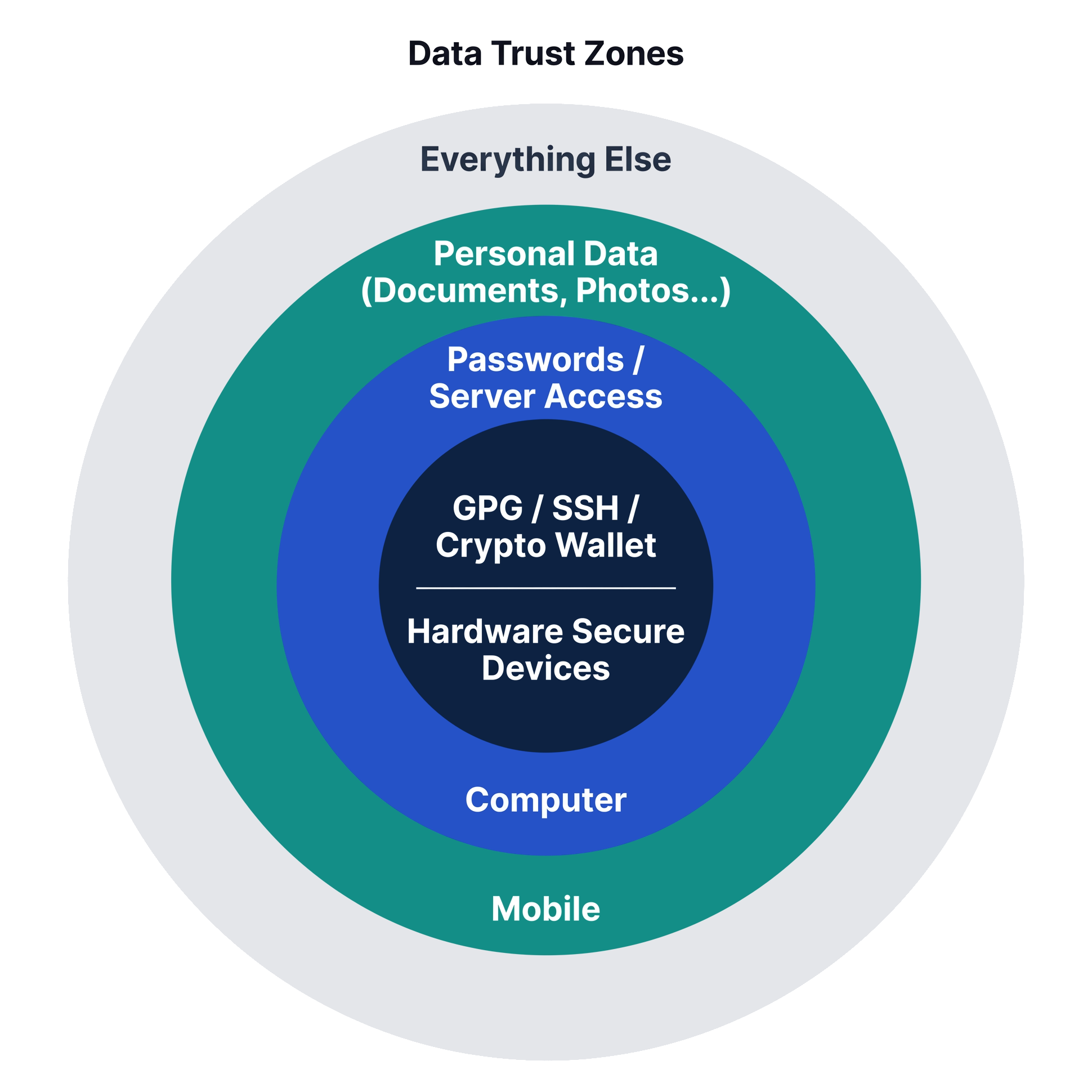
Under this diagram I have to trust the integrity of my computer more than I trust my mobile devices (cellphone, tablet). This makes not only my choice of OS, but how I configure and use it, a key decision.
The evolution of my sweet spot
To better understand how my security sweet spot has shifted, I'll walk through the history of my computer OS of choice:
↓
MS-DOS (early 90s)
↓
Windows (late 90s)
↓
Debian (00s)
↓
Kubuntu (early 10s)
↓
Qubes OS (late 10s)
↓
Arch Linux (20s until now)
I started my computing journey on a ZX Spectrum+ in 1988, it was just games and some BASIC. An IBM PC with MS-DOS came a few years later, and eventually Windows 3.11. With no Internet access to be had at home, and virtually no personal data on my devices (just some schoolwork), privacy wasn't on anybody's mind, or rather it was taken for granted.
Then with Windows 95 I eventually got on the Internet through dial-up, and later ADSL. I started interacting in online communities, downloading media and software. I was a teenager, but luckily sensible enough to use a nickname and not to post names or addresses publicly.
The move from Windows to Debian (after experimenting with other Linux distributions first) was almost an inevitability after getting pilled by the free-software movement. I realized I couldn't trust closed-source software, and felt increasingly uncomfortable with Windows. Once I switched I missed my games (only a few I managed to run with Wine), but I decided to move to console gaming to scratch that itch. My digital sovereignty was more important.
Debian is an amazing distribution, and still my chosen one for servers to this day, but its long gaps between stable releases has always made it a harder sell for desktops. Yes, I used backports, and I ended up running sid, but that meant more instability and breakages occurring from time to time. That's why I ended up moving my laptop to Ubuntu (eventually settling on its Kubuntu flavor), and it was good for a while.
Then I was introduced to Qubes OS by a friend in 2016, and I was blown away by its improved security posture. If you don't know about Qubes OS you might want to read its introduction to realize how different a desktop computer OS could be. If you are feeling lazy the summary is this: in a traditional computer OS all running software gets full access to the computer, to all its files and devices; in Qubes OS however there is a very thin core component of the OS (what they call Dom0) with minimal trusted software, and then absolutely everything else runs in independent isolated virtual machines. That means if you ever run malicious software (virus, trojans, spyware, ransomware, supply chain attacks...), it wouldn't automatically hijack the whole computer and all its data. Breaking the barriers of a VM is not impossible but it is a much harder proposition than other containerization options. It's considered the gold standard of software security, barring running in separate hardware altogether.
I ended up getting a new laptop in 2017 and I installed Qubes OS. I ran it successfully for several years. I felt empowered, confident to run any software with the peace of mind that it couldn't harm my computer, nor access any data it wasn't meant to. However the day-to-day pain proved to be too much for me. The slowness, even with hardware-accelerated VMs, made daily tasks more painful: browsing the web, opening images or PDFs, and particularly my photography workflow was heavily impacted. After a few years I decided that this much security was not warranted for my personal needs, and that I had tilted the balance too much in that direction.
This led me to my last transition. I got a new desktop computer, and settled on Arch Linux for its breadth of up-to-date software and malleability to configure it how I wanted to. I implemented some security practices that would move me towards my sweet spot of security, privacy and UX, like UKI-based end-to-end Secure Boot and lightweight sandboxing of software. I use KDE because it's familiar and very configurable, but modern tiling WMs are very appealing to me, I just cannot justify the time to set one up right now.
What I will be looking for in my future desktop OS
I'm in a happy place right now, with a personal ecosystem that is comfortable and secure enough for my needs. However the hacker mind is restless, and I'm always thinking of how it could be improved.
This is my wish list of features I'd like to see in my next desktop OS:
-
Great UX out of the box. Fast. Responsive. Enjoyable day-to-day. Keyboard-driven. Beautiful. Omarchy already fulfills this point for me, which is what prompted me to write this article.
-
Sandboxed software. Most programs should run in a sandbox by default, in a way that is abstracted away from the user so UX is not impacted. I don't mind prompts for permissions, usually they will be one-time for each program, and a good compromise for security. Have a good GUI to manage permissions, including which files or directories a program has access to (read and/or write).
-
Audited updates. After implementing AI review for the upgrade of my Emacs packages I've been thinking how much I'd like to have the same for my whole OS. I want some guarantee that the software has been audited before it lands on my machine. This is no simple proposition, there are many challenges to overcome, first of all being the sheer size and cost, but I believe there might be solutions through crowdfunding. I think this could be a killer app for Linux, as a closed-source OS wouldn't be able to compete in this arena; you have to trust a third party and can't just trust the code. I'm planning an article to expand on this idea, and maybe I'll work on it as a future project if nobody else picks it up first.
-
Declarative configuration. I kinda regret not jumping onto the NixOS bandwagon instead of deciding on Arch Linux as my latest OS. The reproducibility, ability to share complex configs and to rollback mistakes is very powerful. Plus AI agents simplify making changes. Which leads me to my next point.
-
AI-first. As readers of my blog are already aware of, I've already embraced AI and I'm using it heavily. I'm fully convinced it's here to stay and we need to integrate it and build new systems around it to better serve us. I use it to code, to research, to debug, to learn, to create. However constraining AIs to satisfy my desire for security and privacy hasn't been as straightforward as I'd like. I want my agents to have restricted access to only what they need to get the job done. I want to see an execution plan that I can review and approve. I won't trust an AI with my most personal data unless it runs on my own premises. My ideal OS would integrate AI, but properly sandboxed to cover these and probably other use cases. Omarchy already integrates AI at the OS level, but I'd ask for it to be properly sandboxed.
Nowadays I'm busy with other projects that demand my attention, including a big home remodeling and executing on my new homelab. These endeavors will keep me entertained for several months, during which I would rather not get distracted by also moving my main computer to another OS. However once the house and the homelab are fully up and running I plan on revisiting my choice of desktop OS, at which point I will come back to this wish list and see which Linux distributions implement some of these goals.
Omarchy is improving at an astonishing pace, growing its user base and number of contributors by the thousands. Most of the improvements I read about seem to focus on the desktop and UX, but I wish this humble list gives some food for thought about deeper OS architecture in terms of security and privacy.
In any case I really hope that the positivity that I see in Omarchy lives on. I, for one, am rooting for them.
Got any ideas or feedback? I'd love to hear from you in the comments below, or you can mention me on X.
